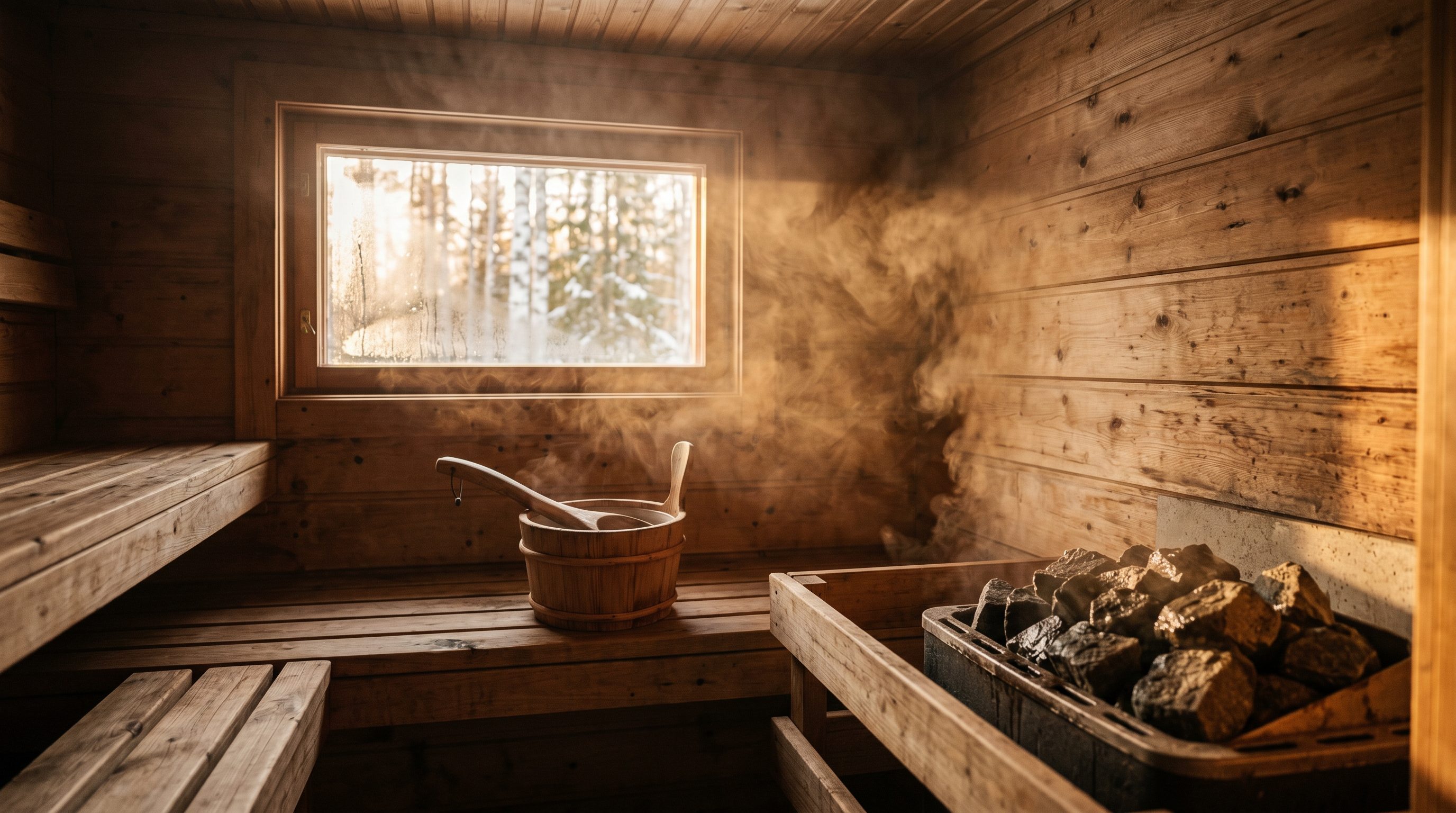

Interior of a traditional Finnish sauna with cedar walls, a wooden ladle and bucket, and hot stones, warm afternoon light through the window

Sauna therapy, the evidence,
and the tradition behind it.

An independent, evidence-first guide to dry, infrared, and steam sauna bathing... honoring an ancient practice and the modern research that has caught up to it.

View through a frosted window to birch trees in a Finnish winter landscape

The tradition behind the research

The sauna is older than most modern medicine. Long before the first randomized trial, Finnish families were born, washed, healed, and mourned in small wooden rooms warmed by stone and fire. The word löyly, the steam that rises when water meets hot stone, carries a meaning closer to "spirit" than to "humidity." That lineage matters. The research that has emerged over the last twenty years has not invented sauna's benefits... it has begun to catch up to what a practice rooted in the long winters of the North has quietly known.

Modalities at a glance

Five categories of sauna, each with a distinct mechanism, temperature range, and evidence base.

Traditional Finnish

Wood-burning or electric stove heats stones to high temperature, with humidity generated by pouring water on the stones (löyly). Dry heat with steam on demand.

Temp range: 70–100°C

The largest evidence base. This is the sauna studied in the KIHD cohort and the Laukkanen body of work. Most observational data on cardiovascular outcomes comes from this modality.

See research →

Far-infrared sauna

Ambient air at lower temperatures. Radiant panels emit long-wavelength infrared that warms the body directly rather than heating the surrounding air. Lower thermal load, often better tolerated by heat-sensitive patients.

Temp range: 45–60°C

Smaller but growing evidence base, particularly from Waon therapy research in Japan for heart failure patients.

See research →

Near-infrared sauna

Shorter-wavelength infrared that penetrates tissue more superficially. Often delivered via LED or incandescent panels at lower ambient temperatures than far-infrared.

Temp range: 40–55°C

Evidence base is thinner than far-infrared. Honest framing: mechanistic plausibility, limited human outcome data at present.

See research →

Steam sauna

High humidity environment at lower temperature. Includes Turkish hammam style. The cardiovascular and thermoregulatory responses differ meaningfully from dry heat at comparable temperatures.

Temp range: 40–50°C, ~100% humidity

Much of the KIHD and Laukkanen work does not generalize directly to steam. Limited but distinct evidence base covering circulatory responses.

See research →

Combination and hybrid systems

Modern cabins that combine infrared panels with conventional heaters, or dry sauna with steam attachments. Offered at many commercial wellness studios.

Temp range: varies by configuration

Evidence base is fragmented. Published research has not studied these hybrid configurations systematically. Relevant for readers who own or use such cabins.

See research →

Three things to know before you step in

01

Hydrate and avoid alcohol

Hydrate before and after, and avoid alcohol around a session. Alcohol is the most consistently identified risk factor in the sauna safety literature, associated with a meaningful share of sauna-related fatalities in population studies.

02

Heat therapy is not for everyone

Unstable cardiac disease, unstable blood pressure, certain medications, recent myocardial infarction, and pregnancy in some contexts are reasons to consult a clinician first. The Research page covers contraindications in detail.

03

Consistency matters more than intensity

Most of the strongest observational data come from people who bathed four to seven times per week over years, not from occasional extreme sessions. Frequency, not heat intensity, is the variable most associated with outcome in the KIHD data.

Where to go next

The Research page synthesizes the evidence base across cardiovascular outcomes, cognition, inflammation, detoxification, and safety, with citations for every claim. If you are looking for a practitioner who incorporates sauna into clinical care, the Find a Provider directory lists clinics that have been reviewed for basic transparency criteria.

If you have heart disease, are pregnant, or take medications that affect blood pressure or fluid balance, talk with your physician before starting a regular sauna practice. That is not a legal disclaimer written to satisfy a lawyer... it is a real recommendation based on what the contraindication literature actually says.